How Can I Know Iphone Photos Are Upload to Icloud
iCloud Photos, formerly known equally iCloud Photo Library, is an Apple service that moves the user's entire photograph and video library into the cloud. It'southward function of Apple's push to get in every bit like shooting fish in a barrel as possible for users to switch among Mac and iOS devices throughout the day, making sure the user'southward photos are bachelor on all of their devices and ensuring any changes get quickly synced beyond devices.
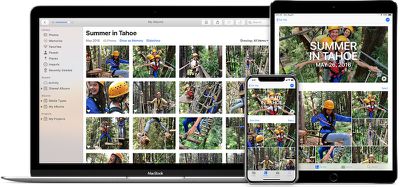
Turning on iCloud Photo Library
- iOS: Open the Settings app and head to account section and tap on your iCloud account. In the "Apps Using iCloud" section, tap on Photos and you'll find a toggle for iCloud Photos. This selection tin can likewise be accessed through the Photos app section of Settings.
- macOS: Open System Preferences and head to the iCloud pane. If y'all're logged in, yous'll see a list of the various iCloud services. Hit the "Options..." button next to Photos, and you lot'll encounter a window where you can turn on iCloud Photos. You lot can also manage settings within the Preferences department of the new Photos app direct.
- Apple TV: On a fourth-generation Apple TV or Apple TV 4K, head to the Accounts section of Settings, and then choose iCloud and turn on the iCloud Photos option.
- iCloud.com: Photos stored in iCloud Photo Library are besides attainable through Apple'southward web-based iCloud.com service. Through the spider web interface, users can upload or download photos, browse via Moments and Albums view, impress or email photos, and mark individual photos as favorites.
iCloud Photos Settings
The Photos apps for Mac and iOS are built to work with iCloud Photos, although users tin opt to use local photograph libraries on their devices if they prefer. Users opting for iCloud Photos have the choice of storing the original photos on their Mac or iOS device, which is ideal for offline access, or a more than flexible optimized arrangement that stores originals locally if you have enough storage infinite merely uses lower-resolution versions if local storage is tight and only downloads the full-resolution versions from iCloud every bit needed.
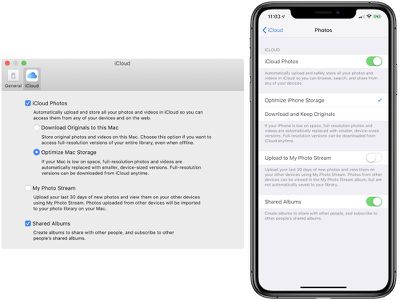
iCloud Photos settings on Mac (left) and iOS (right)
Similar settings are available on iOS, where users can cull between storing full-resolution photos right on their devices or saving some space by storing lower-resolution versions onboard and keeping the total-resolution versions in iCloud.
On iOS and macOS, users may also proceed to see an option for My Photo Stream, which is Apple tree's separate service that allows users to automatically sync their last xxx days' worth of photos (up to one,000 photos) between devices. Users who recently created their Apple tree IDs may not see the My Photograph Stream option, as Apple is phasing out the feature.
On devices where iCloud Photos is agile, there will no longer be a split up My Photo Stream album equally there was prior to the rollout of iCloud Photos, equally all photos are now included in the chief library stored in iCloud. My Photo Stream doesn't count against your iCloud storage limits, just edits made to photos in My Photo Stream don't update across your devices.
The My Photo Stream setting does, however, offer some level of integration between devices where iCloud Photo Library is enabled and those where it is disabled. Turning on My Photo Stream on a device with iCloud Photo Library is enabled allows the device to import Photograph Stream photos from other non-iCloud devices and likewise transport new photos out to My Photo Stream for display on those devices.
Using iCloud Photos
Once you sympathize that iCloud Photos stores and syncs photos beyond devices, usage is very straightforward and information technology behaves very much like a local photo library stored on the user's motorcar. Users can freely manage, edit, and save their photos equally they have always washed, with the added bonus of that piece of work automatically appearing wherever they have iCloud Photos enabled. The original photos always remain stored in iCloud, making it easy to revert any edits fabricated on a device.
As with a local photo library, users can include photos from any source, making iCloud Photos more than the culling Photo Streams of images taken on their devices. Photos and videos of a wide range of types from any source tin can be added to the user'south library on i device, and they will sync to all other devices.
One important consideration when deciding whether or not to utilise iCloud Photos is that it is an all-or-none proposition on a given device unless the user chooses to use multiple photo libraries on macOS. With a single photograph library, in that location is no pick to sync but some photos while the rest is stored only locally. For example, users tin can not opt to have only their iOS device photos synced to their Mac via iCloud Photos but not have their full library of photos in the Photos app for Mac synced to iCloud and the user's other devices unless they want to manage multiple libraries.
Photos are stored in iCloud Photos at their full resolutions and in their original formats. Common formats like HEIF, JPEG, RAW, PNG, GIF, TIFF, HEVC, and MP4 are all supported, every bit are special formats captured on iOS devices like slo-mo, time-lapse, and Live Photos.
Pricing
iCloud Photos taps into a user'due south iCloud account storage, which is also used for iCloud Drive document storage, device backups, and more. iCloud users receive 5 GB of storage for free, only users who wish to support their devices to iCloud frequently detect they need more than that, and iCloud Photograph Library will just increase the need for additional storage.
Apple offers several paid storage tiers for iCloud, priced on a monthly basis and ranging from 50 GB to 2 TB. The everyman paid plan at 50 GB costs $0.99/calendar month in the U.S., with Apple also offer a 200 GB plan for $ii.99/month and a ii TB plan for $9.99/month. Even the high-stop two TB plan may not be enough for some users who take a lot of photos, requiring them to either annal some photos outside of the service or simply opt to not apply iCloud Photos at all.
If y'all fill up up your iCloud storage allotment, new photos and videos volition no longer exist uploaded to iCloud, and libraries volition no longer be synced across devices. In order to restore iCloud Photos functionality, users will demand to either upgrade to a larger storage programme or reduce storage usage by manually deleting certain photos or other files from iCloud.
Turning Off iCloud Photos
Then what if you lot've turned on iCloud Photos and later decide you don't want to use it anymore, either for a specific device or across all devices? On a specific device, iCloud Photos tin be disabled the same way it was turned on, through the iCloud portion of the Settings app on iOS device or Organisation Preferences or Photos preferences on a Mac. If you are currently storing optimized versions of your photos, your system volition requite you the opportunity to download the total-resolution photos from iCloud, at which point you will have a complete local photo library on your device.
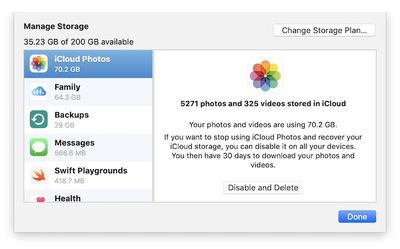
Disabling iCloud Photos entirely in iCloud settings on Mac
If you lot adopt to plough off iCloud Photos entirely, you can head to the Manage Storage section of iCloud settings either in the Settings app on an iOS device or System Preferences on a Mac. In that section, you tin can choose to Disable and Delete iCloud Photo Library, afterwards which indicate you will have 30 days to download your library to at least one device earlier it is removed entirely.
Wrap-up
iCloud Photos represents one of Apple'southward key efforts to streamline the experience of using multiple devices, many of which accept been bundled under the "Continuity" umbrella. Many of these Continuity features tap into iCloud as a method for linking various devices, and iCloud Photos takes that one stride further to ensure the users' photos are available regardless of which device they are currently on.
Related Articles
Apple Launches Service for Transferring iCloud Photos and Videos to Google Photos
Apple tree this week introduced a new service that's designed to go far quick and easy for iCloud users to transfer their stored photos and videos to Google Photos. As outlined in an Apple tree support document, you tin can get to Apple's privacy website and sign in to see the "Transfer a copy of your data" option. If you select this and go through all the steps, Apple will transfer your iCloud photos and ...
iCloud for Windows 5 Adds iCloud Photograph Library and Ii-Factor Authentication
Apple has released iCloud for Windows 5 with support for iCloud Photo Library and 2-factor authentication for Apple ID accounts. Windows users were previously express to accessing iCloud Photo Library through the web interface. Apple recommends that iCloud for Windows users take Windows vii, 8 or 10 installed. For email, the software currently supports Outlook 2007 through Outlook 2013,...
hollandwhatumbigh.blogspot.com
Source: https://www.macrumors.com/guide/icloud-photo-library/
0 Response to "How Can I Know Iphone Photos Are Upload to Icloud"
Post a Comment